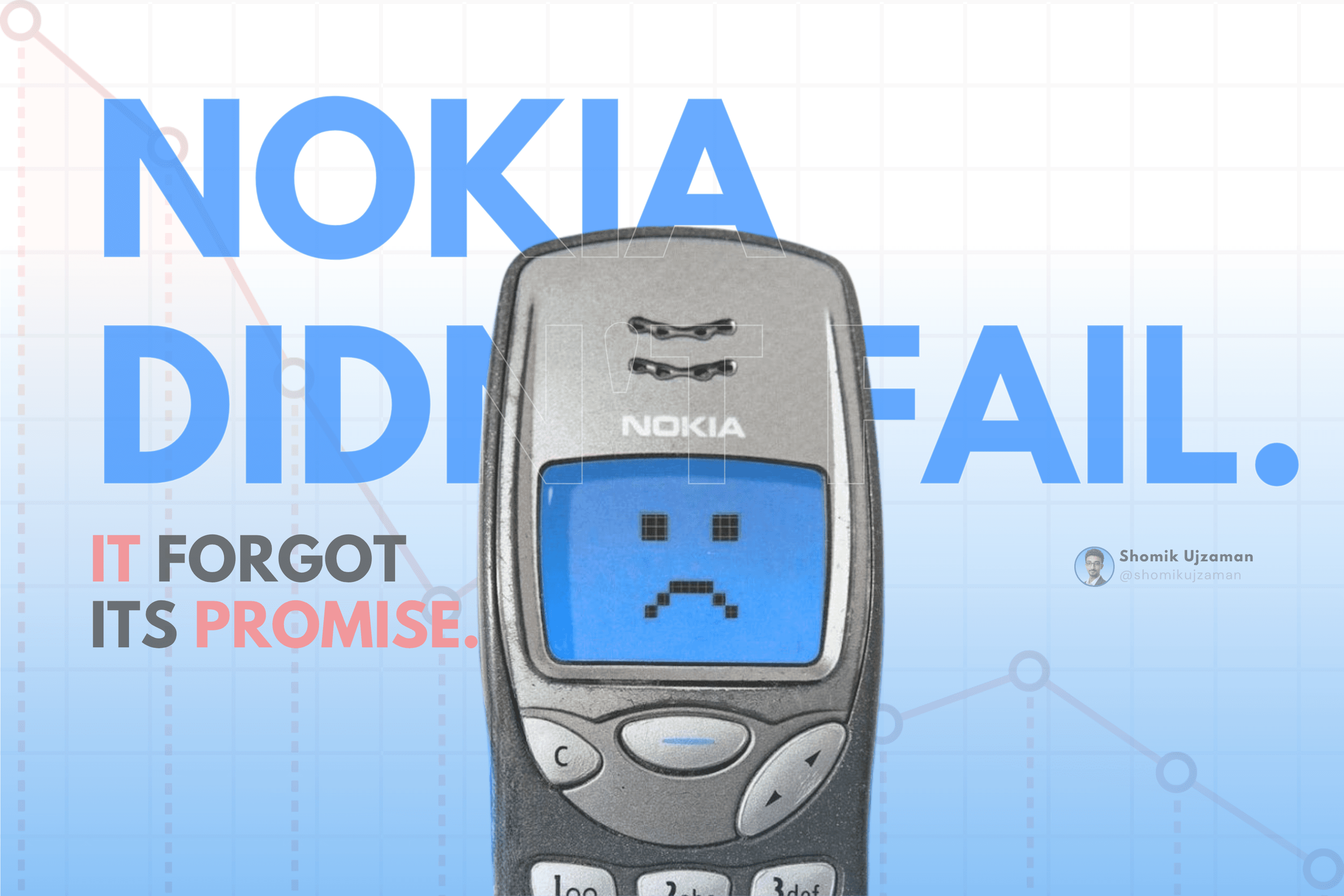
Nokia Did Not Fail Because of Bad Phones. It Failed Because It Broke a Promise.
My first phone was the Nokia 5310 XpressMusic. Chunky buttons, a battery that lasted three days, build quality that could survive a small war. I dropped it on concrete. I sat on it. I probably threw it once during a bad day. It was fine. Completely fine. The phone was basically unkillable and honestly a little intimidating about it.
Then I moved to a Nokia Lumia, their Windows Phone era device. Smooth screen, solid camera, genuinely impressive hardware. Still felt like Nokia. Still had that quiet confidence that said "I will not break and I will not apologize for it."
I am someone who follows trends, thinks about brands, and genuinely gets excited about why certain companies win and others disappear. So when I look back at Nokia today, I do not feel angry. I feel something closer to grief. Because this was not a company that got beaten by a better product. This was a company that had everything, including one of the most powerful brand identities ever built, and then slowly, quietly, forgot what it stood for.
That is the real story. And it is one of the most useful brand lessons available to anyone building something today.
Nokia at Its Peak: Half the World Was Carrying Their Phone
To understand how dramatic the fall was, you have to first sit with how absurd the height was.
In 2007, Nokia controlled nearly 49.4% of the global smartphone market. Not a niche. Not a region. Half the smartphones on planet Earth were Nokia phones. The company was shipping over 435 million units a year. Its brand was one of the most recognised in the world, sitting comfortably alongside Coca-Cola and Nike in terms of global recall.
If you said "Nokia" to anyone in 2005, they did not need to think. The image arrived instantly. Durable. Long lasting. Reliable. The phone you could use for five years and it still felt solid. The phone your parents trusted. The phone that survived being dropped down a flight of stairs while your heart did not.
That kind of brand clarity is genuinely rare. Most companies spend decades chasing it. Nokia had earned it through years of consistent product delivery, and it was sitting in the minds of hundreds of millions of people like a locked-in truth.
That was Nokia's most valuable asset. More valuable than its factories. More valuable than its patents. More valuable than anything on the balance sheet.
They just did not realize it until it was gone.
Enter the iPhone: Nokia Laughed. Nokia Should Not Have Laughed.
January 2007. Steve Jobs walks on stage in San Francisco and introduces the iPhone. No physical keyboard. Short battery life compared to Nokia standards. Premium price. A product from a computer company that had never made a phone before.
Nokia's reaction was essentially: cute.
And to be fair, the numbers backed up that confidence. By the end of 2007, Nokia still held 50% of the smartphone market. Apple sat at just 5%. Samsung was not yet the force it would become. Why would a company with half the market panic about a niche product from a guy who made music players?
Here is why. The iPhone was not competing with Nokia's hardware. The iPhone was rewriting the definition of what a phone was supposed to do. It shifted the entire conversation from hardware durability to software experience, app ecosystems, touchscreen interaction, and seamless design. Nokia was very good at building the best version of something the world was about to stop caring about.
While Apple and Google were racing to build platforms that developers loved and users got addicted to, Nokia was still doubling down on Symbian, their own operating system. Symbian had served Nokia well in a simpler time. But it was not built for a touchscreen world. Developers found it painful to work with. Users found it clunky next to iOS and Android. By 2011, Symbian's share of the app market had collapsed from 52% to just 2%.
Nokia was not losing a feature war. Nokia was losing a relevance war. And relevance, once lost, is not recovered by shipping a slightly better camera.
The Burning Platform Memo: A Diagnosis With the Wrong Prescription
In February 2011, Nokia's CEO Stephen Elop sent an internal memo that has since become legendary in business school classrooms. He compared Nokia's position to a man standing on an oil platform that was on fire. Jump into the cold water or burn. There was no comfortable third option.
He was absolutely right about the diagnosis.
The prescription, however, was the kind of bold strategic gamble that looks visionary in a pitch deck and catastrophic in hindsight. Instead of adopting Android, the platform that was already winning the developer and consumer war, Nokia chose to partner with Microsoft and build smartphones running Windows Phone. The result was the Nokia Lumia series, launched in late 2011.
The hardware was genuinely impressive and deserves some credit here. The Lumia 920 had optical image stabilisation before most of its competitors. It had wireless charging built in before that was considered standard. The design was colourful, bold, and distinctive in a market that was becoming increasingly generic and black rectangle shaped.
But the ecosystem was nearly empty. Consumers had already built their digital lives around the App Store and the Play Store. They had their apps, their subscriptions, their habits. Nokia's Windows platform had a fraction of the apps people depended on daily, limited customisation, and slower updates. Nobody was going to rebuild their entire phone life for a platform that was starting from behind.
By 2012, Nokia posted a loss of 4.9 billion euros. Their first annual loss since entering the mobile phone business in 1992. Their market share, which had been nearly 50% just five years earlier, was now less than 5% and still falling.
In 2014, Nokia sold its entire mobile phone business to Microsoft for 5.4 billion euros. The Lumia line survived under Microsoft for a couple more years, looking increasingly like a brand that no one had the heart to officially bury, and then it quietly stopped. Nokia's mobile chapter appeared to be over.
The HMD Comeback: Nokia Returns, Nobody Notices
Plot twist. In 2016, a Finnish company called HMD Global acquired the Nokia brand and started manufacturing Android smartphones. Nokia was back. New phones, clean Android software, the familiar logo on the back.
The tech press wrote the comeback articles. The nostalgia crowd got momentarily excited. A few people who remembered their old 3310 with genuine affection paid attention.
And then the phones came out and they were fine. Perfectly fine. Completely, utterly, competitively, forgettably fine.
They were mid-range Android phones in a market already drowning in mid-range Android phones. Decent cameras. Clean software. No reason to pick them over Samsung, Xiaomi, Motorola, or half a dozen other options at the same price point. Nothing about the product said Nokia in any way that connected to what Nokia had always meant.
By 2024, Nokia's global smartphone market share had fallen below 1%. A company that once owned half the world's smartphone market now held a rounding error of it.
The comeback failed. Not because the phones broke. Because nothing about them carried the brand home.
The Real Lesson: You Cannot Break a Promise and Call It a Pivot
Here is the thing that I keep thinking about as someone who works in brand content and strategy.
Close your eyes right now and think about Nokia. Not the company news. Not the market share numbers. Just the word Nokia.
What do you see?
A tough phone. A durable phone. A phone that does not care that you dropped it. That image is still alive in 2026, decades after Nokia stopped deserving it. Nokia spent so many years building that association that it outlived the company's ability to deliver on it.
That is actually extraordinary. Most brands would kill for that kind of lasting mental real estate.
And Nokia wasted it. Twice.
The first waste was refusing to evolve the platform when the market shifted. That cost them relevance and market share and eventually the business itself.
The second waste, which is the one that keeps me up at night from a brand strategy perspective, was coming back to the market in 2016 without carrying the promise with them. When HMD Global relaunched Nokia on Android, those phones needed to be the most durable, most reliable, most long lasting Android phones available at any price point. That positioning was completely open. Nobody in 2016 was saying "we make the phone that never dies." That lane belonged to Nokia. It was theirs by reputation, by history, by the memory of every person who ever dropped a 3310 and watched it survive.
They walked away from it and made a generic mid-range phone instead.
In brand strategy, there is one principle that does not have exceptions. Whatever expectation you build in your audience's mind, every product you release must reinforce it. Set the promise. Protect the promise. Deliver the promise. The moment your product contradicts what your brand stands for, you lose something that no marketing budget can buy back.
Nokia set the promise perfectly. Nokia protected it for years. And then Nokia abandoned it at the two most critical moments in the company's entire history.
What This Means If You Are Building a Brand Right Now
Nokia's story is not really about smartphones. It is about the gap between what a brand says and what a brand does. And that gap exists in every category, at every scale, from a multinational with 50% global market share to a one-person content creator building a presence on LinkedIn.
If you are building a personal brand, a product brand, or a company brand right now, here is what Nokia's collapse actually teaches you.
Your brand promise is your most protected asset. More than your logo, more than your color palette, more than your tagline. The mental image you build in your audience's mind is the thing that makes them choose you without thinking too hard. Guard it in every piece of content you publish, every product you release, and every campaign you run.
Pivoting your product does not mean abandoning your identity. Nokia could have entered Android as the most durable, most dependable, most long lasting device on the market. The technology shift did not require a personality shift. They chose to forget themselves when they needed to remember themselves most.
Consistency is what turns a product into a brand. Anyone can make a phone. Only Nokia had the history to make the phone that never dies. They gave that away for free.
And finally, brand equity does not last forever without feeding. The image people carry of your brand will fade or get overwritten if your products stop reinforcing it. Nokia let the image survive in people's heads while selling products that quietly contradicted everything that image stood for.
You can survive being late to a market. You cannot survive being a stranger to your own brand.
Nokia still has a name that means something to a generation of people who grew up with their phones in their pockets. That is an asset sitting untouched and underused. If someone ever figures out how to match a modern product to that old promise, they will have something genuinely powerful on their hands.
Until then, Nokia remains one of the most useful case studies in what happens when a brand forgets what made it matter.
If you found this useful, you might also enjoy reading about why meme culture became a serious content strategy in 2026 and how LinkedIn is slowly turning everyone into the same person. Both are on the blog.
And if you want to talk about brand content, SEO, or building something that actually connects with people, let's start a conversation.